Introduction
Frequent power outages, off-grid rural houses, residential solar self-consumption, and RV outdoor power all rely on inverters. However, many homeowners run into problems after purchase: air conditioners fail to start, refrigerators trip on startup, or household appliances burn out within half a year. These issues almost always stem from incorrect inverter selection.
This easy-to-follow guide breaks down inverter selection from 5 core dimensions: usage scenarios, output waveform, power rating, DC battery voltage, and common pitfalls, helping you pick the right home inverter once and for all.
1. Three Main Types of Inverters – Match Them to Your Needs
The first step before buying is to identify your application. These three categories cannot be interchanged, and mismatched units waste your investment.
1.1 Grid-Tied Inverters (Best for Urban Homes with Rooftop Solar)
Suitable for: Houses connected to utility grids with rooftop solar panels; users who want self-consumption plus selling excess power back to the grid.Core Features:
Only operates when grid power is available; auto-shuts down during blackouts (anti-islanding protection mandated by grid safety codes).
No batteries required; solar power directly supplies household loads, and surplus electricity flows back to the grid for credits.
Two variants: Microinverters and string inverters. Microinverters perform better for shaded rooftops; string inverters suit large roof areas with multiple independent MPPT trackers to minimize power loss.
Drawback: Cannot act as backup power during outages; fully relies on grid supply at night.
1.2 Off-Grid Inverters (For Rural Homes, Islands, RVs & Standby Power)
Suitable for: Remote areas without utility power, locations with regular blackouts, systems needing round-the-clock battery power supply.Core Features:
Creates standalone AC power without grid connection; works with solar panels and batteries 24/7.
Built-in MPPT solar charge controller to recharge batteries in the daytime; batteries discharge to power appliances after dark.
Two designs: Separate charge-invert units and all-in-one hybrid off-grid inverters. All-in-one models simplify wiring and are preferred for residential use.
Drawback: Requires large-capacity battery packs, leading to higher upfront system costs.
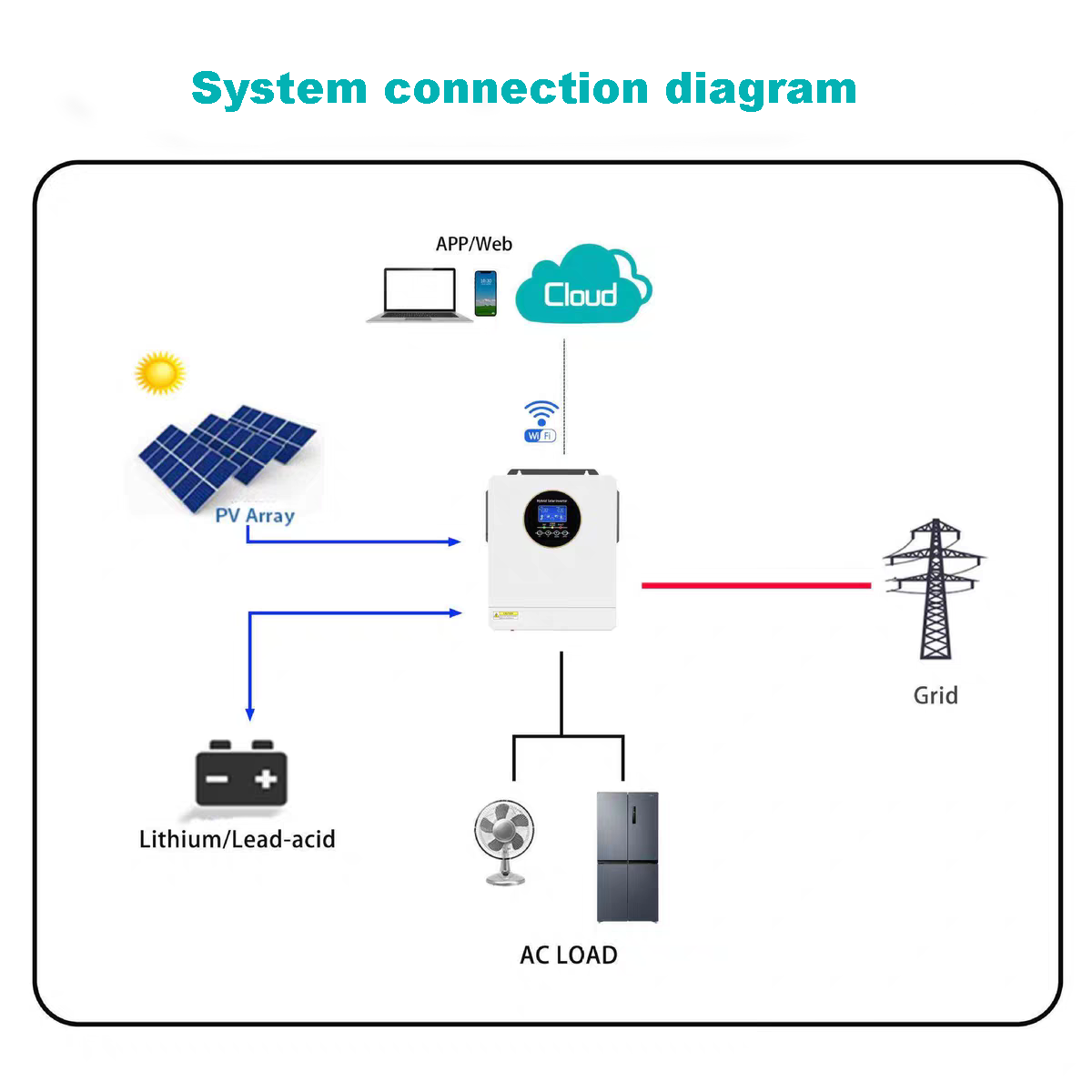
1.3 Hybrid Grid-Tied/Off-Grid Inverters (All-Round Top Pick for Most Families)
Suitable for: Households wanting solar savings while avoiding power cut disruptions.Core Features:
Runs on grid power for solar feed-in; seamlessly switches to battery-powered off-grid mode the moment the grid fails for uninterrupted loads.
Tri-directional energy flow among solar panels, utility grid and batteries – the mainstream choice for modern residential solar setups.
Customizable energy logic: Self-consume solar power, store surplus energy in batteries for peak-hour usage to cut electricity bills.
2. Only Pure Sine Wave Works for Homes – Modified Sine Wave Is Not Recommended
Three output waveforms exist on the market with massive performance gaps that directly determine the service life of your home appliances.
Pure Sine Wave (Only Acceptable Option for Household Use)
Its waveform matches commercial grid electricity perfectly with minimal harmonic distortion. Fully compatible with air conditioners, refrigerators, washing machines, computers, speakers and all variable-frequency devices. Motors run quietly without overheating, with zero long-term damage to electronics. High-quality models achieve conversion efficiency above 95% for maximum energy savings.
Modified Sine Wave (Only for Temporary Resistive Loads)
Half the price of pure sine wave units but generates stepped approximate waveforms. Running compressors or variable-frequency equipment will cause frequent refrigerator shutdowns, loud AC noise, overheated PC power supplies and speaker static. Long-term operation risks permanent damage to precision electronics. Only fit simple resistive loads like light bulbs and electric heaters – never for full home use.
Square Wave (Obsolete, Avoid Completely)
Outdated low-end products that cause violent vibration in motors once connected. Not fit for any household scenario.
3. How to Calculate Required Power
– Most Buyers Make Inverters list two power ratings: Continuous Rated Power and Peak Surge Power. Both figures must be checked, especially for appliances with electric motors such as fridges and air conditioners.
Basic Calculation Formula
Minimum Inverter Rated Power ≥ Total Wattage of All Simultaneously Running Loads ÷ 0.9 × 1.2 (20% safety margin reserved)
Critical Note: Multiply Power for Motor Startup
Refrigerators, air conditioners, water pumps and washing machines draw 3–7 times their rated current during startup:
Calculation Example
Simultaneous loads: 200W fridge, 1500W variable-frequency AC, 300W TV, 100W lightingCalculation: (200×7 + 1500×4 + 300 + 100) ÷ 0.9 × 1.2 ≈ 10,800WA minimum 10kW pure sine wave inverter is required.
Home Power Selection Reference
Small apartment emergency use (lights, TV, mini fridge): 1,500W – 3,000W
2-bedroom full basic loads (1HP AC + kitchen appliances): 4kW – 6kW
3-bedroom complete household (2HP AC, water heater, washing machine): 8kW – 10kW
Large self-built house heavy loads (3HP cabinet AC, electric water heater): 10kW and above
4. Match DC Battery Voltage
– Avoid 12V for High-Power Systems
Off-grid and hybrid inverters feature 3 common DC input voltages: 12V, 24V, 48V, which must perfectly match your battery bank series setup – mixing voltages burns equipment instantly.
12V: Only for inverters under 1,500W, suitable for small RV portable systems. High current leads to overheated thin cables for heavy loads.
24V: Mid-range home systems from 2kW to 4kW, ideal small-home backup power.
48V: Standard for whole-house inverters over 4kW. Lower current reduces cable loss and heat generation, the unified recommended voltage for full-home solar & energy storage systems.
Reminder: A 48V inverter only works with four 12V batteries wired in series; mismatched voltage configurations will destroy the unit.
5. Five Non-Negotiable Standards for Inverter Purchase
5.1 Conversion Efficiency ≥ 94%
Premium residential inverters meet a minimum full-load efficiency of 94%. Every 1% efficiency drop wastes hundreds of kWh annually, far exceeding the initial price difference. Prioritize models maintaining over 90% efficiency under 20% light loads for daily low-power operation savings.
5.2 Full Set of Safety Protection Functions
Mandatory protections: Low DC voltage shutdown, overvoltage protection, overload protection, short-circuit protection, thermal power derating, surge lightning protection. For mountainous thunderstorm-prone areas, select units with IP54 or higher dust & waterproof ratings.
5.3 Optimized Heat Dissipation
Choose models with intelligent temperature-controlled dual cooling fans with variable speed for quiet long-hour operation. Single-fan units or those without thick aluminum heat sinks risk overheating shutdowns in summer.
5.4 Intelligent Remote Monitoring
Built-in mobile APP support to track power generation, real-time load wattage and battery SOC; remote parameter adjustment simplifies daily maintenance.
5.5 Warranty Term
Grid-tied inverters require a minimum 5-year warranty; hybrid energy storage all-in-one inverters are recommended with 6–10 year coverage. Inverters are long-term core equipment, so reliable after-sales service is critical.
6. Five Common Misconceptions for First-Time Buyers
Misconception 1: Only Look at Peak Power, Ignore Continuous Rated Power
Many merchants advertise 6,000W peak output with a true continuous rating of only 3,000W, triggering immediate shutdowns under sustained heavy loads. Always judge by continuous rated power; peak ratings only handle split-second startup surges.
Misconception 2: Save Money on Modified Sine Wave Units
Modified sine wave inverters cost several hundred less upfront but lead to expensive motor repairs for fridges and air conditioners within half a year – repair fees far outweigh the initial savings.
Misconception 3: Run Full House Loads on 12V Low-Voltage Batteries
High-power 12V systems draw hundreds of amps, creating severe fire hazards from overheated thin wires. All systems above 4kW must adopt 48V architecture.
Misconception 4: Use Grid-Tied Inverters as Blackout Backup Power
Grid-tied inverters lack off-grid energy storage capability and cut power the second the grid fails. Select hybrid models if you require emergency backup.
Misconception 5: Over-Size Solar Panels Without Proper DC/AC Ratio
The recommended solar panel total power is 1.1–1.2 times the inverter rating. Excess PV capacity triggers power limiting under strong sunlight, wasting potential generation output.
7. Quick Selection Cheat Sheet for Direct Reference
Urban residential solar, no blackout backup needed: String-type pure sine wave grid-tied inverter
Off-grid rural homes / frequent outages, full-house energy storage: 48V pure sine wave hybrid inverter
RV & temporary outdoor small loads: 12V / 24V compact off-grid pure sine wave inverter
All household scenarios: Never choose modified or square wave inverters
Power calculation rule: Factor in motor startup surge multipliers and reserve a 20% power margin
Conclusion
The inverter acts as the core heart of solar power and backup energy systems, with a service lifespan up to a decade if properly selected. There is no need to oversize blindly; simply match the unit to your household load profile, account for appliance startup surges, and stick to pure sine wave output to avoid 99% of purchasing mistakes.
Save this guide if you plan to install rooftop solar or backup power – cross-check all technical parameters before placing your order!








 +86-18718357506
 daisy@sstpowerltd.com
 English

 Español
 русский
 Français
 Deutsch
 عربي
عربي
 Portuguê
 Italiano
 한국어
한국어